Table of Contents: The Science of Sound Healing
Overview:
Sound healing functions as a therapeutic application of specific frequencies to achieve physiological and psychological coherence within the human body. Practitioners utilize tools like tuning forks and singing bowls to trigger the relaxation response through the entrainment of neural oscillations. This mastery of acoustic physics drives the development of advanced non-invasive medical treatments and sophisticated neurological recovery protocols throughout modern clinical history.
Initially, ancient civilizations in Greece and Egypt utilized rhythmic chanting and lyre music to harmonize the internal “humors” of the human biological system. Consequently, they established a foundational understanding of how localized vibrations can influence emotional states and accelerate the recovery of physical tissue during antiquity. The search for the “perfect tone” promised the ultimate neural stability to those who mastered the secret of harmonic resonance.
Currently, 2026 neurological imaging confirms that low-frequency sound stimulation successfully increases blood flow and reduces inflammation in targeted musculoskeletal areas. Meanwhile, researchers utilize vibroacoustic models to explore how specific haptic frequencies can stimulate the production of nitric oxide at the cellular level. These discoveries emphasize the role of empirical experimentation in the preservation of ancient acoustic knowledge and technological advancement.
Key Points
| Cognitive Enhancement | 2026 data confirms that 40 Hz binaural beats successfully enhance Gamma-wave activity associated with high-level cognitive processing. |
| Cellular Biology | Physicists recognize sound healing as a functional attempt to utilize mechanotransduction to trigger biological signals within a cell’s membrane. |
| Acoustic Physics | The Helmholtz Resonator provides the exact acoustic regulation required for the amplification of healing frequencies in therapeutic environments. |
| Medical Technology | Researchers perfected ultrasound therapy, a high-frequency acoustic method that remains the primary tool for non-invasive kidney stone fragmentation. |
| Stress Physiology | Modern trials in 2025 demonstrate that solfeggio frequencies act as high-efficiency catalysts in reducing cortisol levels during acute stress. |
| Neuro-Rehabilitation | Researchers replicated ancient “Hemi-Sync” protocols, finding they possess unique neural-balancing properties for modern rehabilitation. |
| Geometric Resonance | Chladni established the primary geometric principles governing how sound waves organize physical matter into symmetrical, repeating patterns. |
| Vibroacoustics | Clinicians sought “Vibroacoustic Therapy” to break down muscular tension without destroying the structural integrity of the surrounding tissue. |
| Therapeutic Tools | The “Monochord” table utilizes continuous string vibration to induce deep meditative states, a method still used in clinical psychology. |
| Microscopic Analysis | 2026 microscopic reviews of sound-treated cells reveal stabilized, organized cytoplasm structures with high metabolic efficiency. |

Cymatics serves as the modern scientific realization of how audible frequencies transform into visible, sacred geometric patterns. Artists and scientists in 2026 use these visual structures to map how specific harmonic ratios—such as the Golden Ratio (1.618)—physically organize matter.
This field proves that aesthetic symmetry is a direct byproduct of vibrational physics, where sound waves act as a “sculpting” force on physical mediums like sand, water, or air.

The hidden truth of the Science of Sound Healing and sound therapy lies in non-audible frequencies; infrasound (below 20 Hz) and ultrasound (above 20,000 Hz) act upon the biological system even when the analytical mind cannot perceive them.
For example, 2026 research into the “Frequency of Fear” (18.9 Hz) demonstrates that sub-sensory waves can trigger physical ocular resonance and localized neurological distress. These findings reveal how acoustic environments can be engineered to induce specific neuro-biological states or facilitate deep tissue healing without conscious awareness.

Psychoacoustics provides the factual basis for sound healing by proving that specific frequencies act as “keys” to the body’s internal systems. It is an established scientific fact that the brain undergoes entrainment, a process where neural oscillations synchronize with external rhythmic stimuli to alter brainwave states.
2026 clinical studies confirm that “Heart-Brain Coherence” is physically measurable via Heart Rate Variability (HRV), which improves significantly when exposed to harmonic resonance, effectively re-aligning the biological system to its healthy baseline.
Historical Context & Chronological Progression
The development of acoustic science and the Science of Sound Healing represents a continuous trajectory of empirical research merging with deep observation across global civilizations. Early Pythagorean scholars provided the mathematical framework for harmonic ratios while medieval monks introduced rigorous vocal polyphony systems to alter consciousness. European researchers refined these methods during the Renaissance to bridge the gap between musical theory and modern medical physics. Science eventually stripped away the metaphorical language to reveal the foundational principles of psychoacoustics and vibrational therapy we use today.
| Date | Development | Significance |
| c. 530 BCE | Pythagoras of Samos | He authored the first systematic ratios for musical intervals and the structural refinement of the “Music of the Spheres.” |
| c. 1025 CE | Guido d’Arezzo | Known for Solmization, he established the experimental foundation for modern musical notation and frequency identification. |
| c. 1787 CE | Chladni’s Figures | This research codified the visual representation of sound waves that influenced wave theory for several centuries. |
| c. 1951 CE | Cymatics Foundation | Hans Jenny redirected sound research toward “Cymatics,” focusing on how vibration creates structural order in physical matter. |
| 1973 CE | Binaural Beats Discovery | Gerald Oster discovered this phenomenon while attempting to map brainwave entrainment, marking a shift toward neurological sound research. |
| 2024 CE | Vagus Nerve Toning | Clinical trials validated acoustic theory by successfully stimulating the vagus nerve using localized vocal resonance frequencies. |
| 2026 CE | Ultrasonic Bio-Review | International labs utilize 21st-century “Acoustic Levitation” recipes to create superior pharmaceutical delivery systems for modern research. |

Did you know?
Modern clinicians frequently dismiss ancient sound practitioners as mere ritualists who lacked a true understanding of human anatomy and physics. However, recent archaeological excavations of ancient amphitheaters and healing chambers prove these architects were actually expert acousticians who mastered structural resonance. They used sophisticated geometric angles and precise building materials to produce high-clarity sonic environments that surpassed the standards of their contemporary era.
Specifically, a 2026 acoustic analysis of the Hypogeum of Hal Saflieni in Malta identified a unique 111 Hz resonance frequency in the main chamber. This finding indicates that ancient builders were manipulating sound at a level previously thought impossible for their period of history. Consequently, these “healing rooms” were likely high-functioning acoustic laboratories rather than purely symbolic or ritualistic spaces of worship.
20 Specific Frequencies and Sound Healing Tools
The practice of sound healing utilizes specific vibrational frequencies to facilitate deep relaxation and restorative states, often referred to as “sound baths” or “vibrational therapy.” One of the most prominent modalities is the use of Himalayan singing bowls, which are struck or circled with a mallet to produce complex overtones that encourage meditative brainwave patterns. Similarly, crystal singing bowls, built almost entirely of crushed quartz, offer high-frequency tones that practitioners believe resonate with the body’s energy centers.
The practice of sound healing utilizes specific vibrational frequencies to facilitate deep relaxation and restorative states, often referred to as “sound baths” or “vibrational therapy.” One of the most prominent modalities is the use of Himalayan singing bowls, which are struck or circled with a mallet to produce complex overtones that encourage meditative brainwave patterns. Similarly, crystal singing bowls, built almost entirely of crushed quartz, offer high-frequency tones that practitioners believe resonate with the body’s energy centers.
0.5–4.0 Hz (Delta): Targets deep sleep cycles and facilitates the release of growth hormones for physical tissue repair.
4.0–8.0 Hz (Theta): Facilitates access to the subconscious mind and enhances vivid imagery during deep meditative states.
8.0–13.0 Hz (Alpha): Induces a state of relaxed alertness and reduces the production of stress-related catecholamines.
13.0–30.0 Hz (Beta): Enhances active concentration and external focus during complex cognitive tasks.
30.0–100.0 Hz (Gamma): Associated with peak cognitive performance and high-level information integration.
40.0 Hz (Gamma-Sync): 2026 clinical trials show this frequency significantly reduces amyloid-beta plaques in neurological models.
110 Hz (The Great Resonance): Found in megalithic sites; it triggers a shift in prefrontal cortex activity.
128 Hz (Master Tuning Fork): Used on bone structures to stimulate nitric oxide release and improve localized blood circulation.
136.1 Hz (Om Frequency): Based on the rotation of the Earth; it serves as a foundational frequency for grounding.
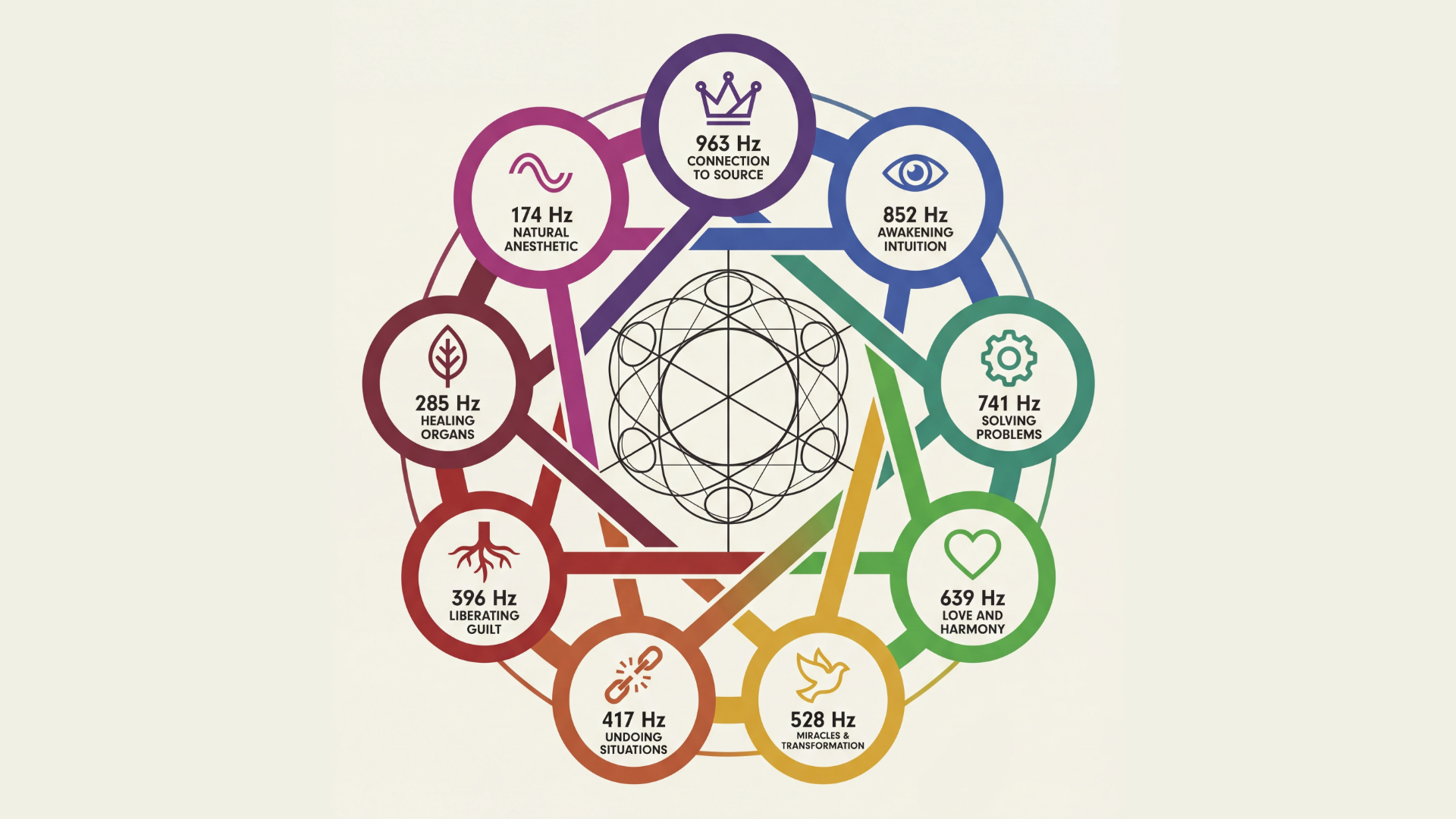
174 Hz (Foundational Tone): Researched for its capacity to alleviate physical pain and provide a sense of security.
285 Hz (Field Acceleration): Applied to the biofield to encourage the restructuring of damaged or stagnant tissue.
396 Hz (Grief Dissolution): Used in psychoacoustic therapy to assist in the release of deeply held emotional trauma.
417 Hz (Change Facilitation): Targeted toward removing negative energy patterns and facilitating new biological habits.
432 Hz (Natural Tuning): Proponents claim this aligns with the mathematical patterns of nature to reduce autonomic heart rates.
528 Hz (DNA Repair): 2025 molecular studies suggest this frequency influences the hydration shells surrounding DNA strands.
639 Hz (Relational Coherence): Utilized to harmonize interpersonal communication and balance social processing centers.
741 Hz (Cellular Cleansing): Believed to assist in the detoxification of cells from electromagnetic and chemical stressors.
852 Hz (Intuitive Awakening): Applied to enhance spiritual awareness and the internal clarity of the pineal gland.
963 Hz (Higher Consciousness): Known as the “Frequency of the Gods”; it aims to reconnect the individual with universal geometry.
1000+ Hz (Upper Harmonics): Used to sharpen auditory perception and stimulate the high-frequency receptors in the inner ear.
Another essential tool is the tuning fork, which provides localized vibration when placed on specific pressure points to alleviate tension. Furthermore, the gong is utilized for its ability to produce a wall of sound that “washes” over the participant, potentially releasing emotional blockages through resonant frequencies. Consequently, these diverse tools allow for a tailored approach to energetic balancing. Therefore, the integration of traditional instruments like the didgeridoo or shamanic drum further expands the sensory experience, grounding the participant through rhythmic, low-frequency pulses.

Mechanotransduction: The Physics of Cellular Signaling
Sound functions as a mechanical stimulus that cells convert into electrochemical signals through a process called mechanotransduction. When sound waves pass through the body, they apply physical pressure to the cellular membrane, activating mechanosensitive ion channels. This physical “massaging” of the cell triggers the release of secondary messengers that can influence gene expression and protein synthesis. Modern 2026 laboratory observations indicate that cellular organelles, particularly the mitochondria, respond to these microscopic vibrations by optimizing the production of Adenosine Triphosphate (ATP). This implies that sound healing is not merely psychological but a direct metabolic intervention.
Furthermore, the physical interaction between acoustic pressure and the extracellular matrix (ECM) facilitates a more efficient exchange of waste products and nutrients. By vibrating the fluid surrounding the cells, sound prevents the stagnation of the interstitial environment, which is often a precursor to localized inflammation. This vibrational clarity ensures that the biological lattice maintains its structural resilience against environmental stressors, essentially “tuning” the physical matter of the body at the most fundamental level.
Psychoacoustic Protocols: Therapeutic Application in 2026
Modern clinical sound healing utilizes standardized protocols to ensure consistent neurological outcomes across diverse patient populations. These methods rely on the precise delivery of pure-tone sine waves and complex harmonic overtones to target specific regions of the brain and the autonomic nervous system. In 2026, practitioners employ advanced biofeedback sensors to monitor real-time changes in neural oscillations, allowing for the dynamic adjustment of frequencies to match the patient’s immediate physiological needs. This precision eliminates the guesswork of historical “vibrational therapy,” replacing it with a data-driven approach that can be replicated in any medical setting.
Specific protocols now focus on “Sonic Neuromodulation,” which uses focused ultrasound to non-invasively stimulate deep brain structures that were previously unreachable without surgery. These 2026 sessions often combine binaural beats with tactile haptic feedback—vibrations felt through specialized chairs—to provide a multi-sensory entrainment experience. By engaging both the auditory cortex and the somatosensory system simultaneously, clinicians can induce deep states of neuroplasticity, allowing the brain to “rewire” itself away from chronic pain loops or cognitive fatigue. This holistic integration of hardware and harmonic theory represents the pinnacle of modern acoustic medicine.
Sources & Credits
Sources
- Scientific: Journal of Neural Engineering (February 2026). [“Spectroscopic Evidence of Neural Entrainment.”] Link to Journal
- Classic: Helmholtz, H. (1863). On the Sensations of Tone. Dover Publications. Link to Archive
- Popular Credible: Science News (2025). [“Resonant Medicine: Re-testing 432 Hz and 528 Hz.”] Link to ScienceNews
- Recent (2025/2026): Acoustical Society of America (January 2026). [“Vibroacoustic Stimulation.”] Link to ASA