Table of Contents: The Black Madonna and Hidden Symbolism
Overview
The Black Madonna and Hidden Symbolism represent one of the most intriguing mysteries in religious iconography, standing as a testament to the intersection of ecclesiastical art and ancient chthonic worship. These dark-toned figures appear throughout Europe, yet their origins often predate the traditional Christian narrative, drawing heavily from the “Black Isises” of Egypt and the Greco-Roman Ceres.
Initially, many scholars linked these depictions to ancient earth deities and fertility goddesses who resided in the fertile silt of riverbanks and the darkness of caves. Consequently, the transition from pagan archetypes to Christian icons allowed for the preservation of deep, subterranean wisdom, effectively “baptizing” the primordial reverence for the Great Mother. Currently, researchers use advanced carbon-14 dating and dendrochronology to trace the physical age of these statues, often discovering that the wood itself originated from sacred groves.

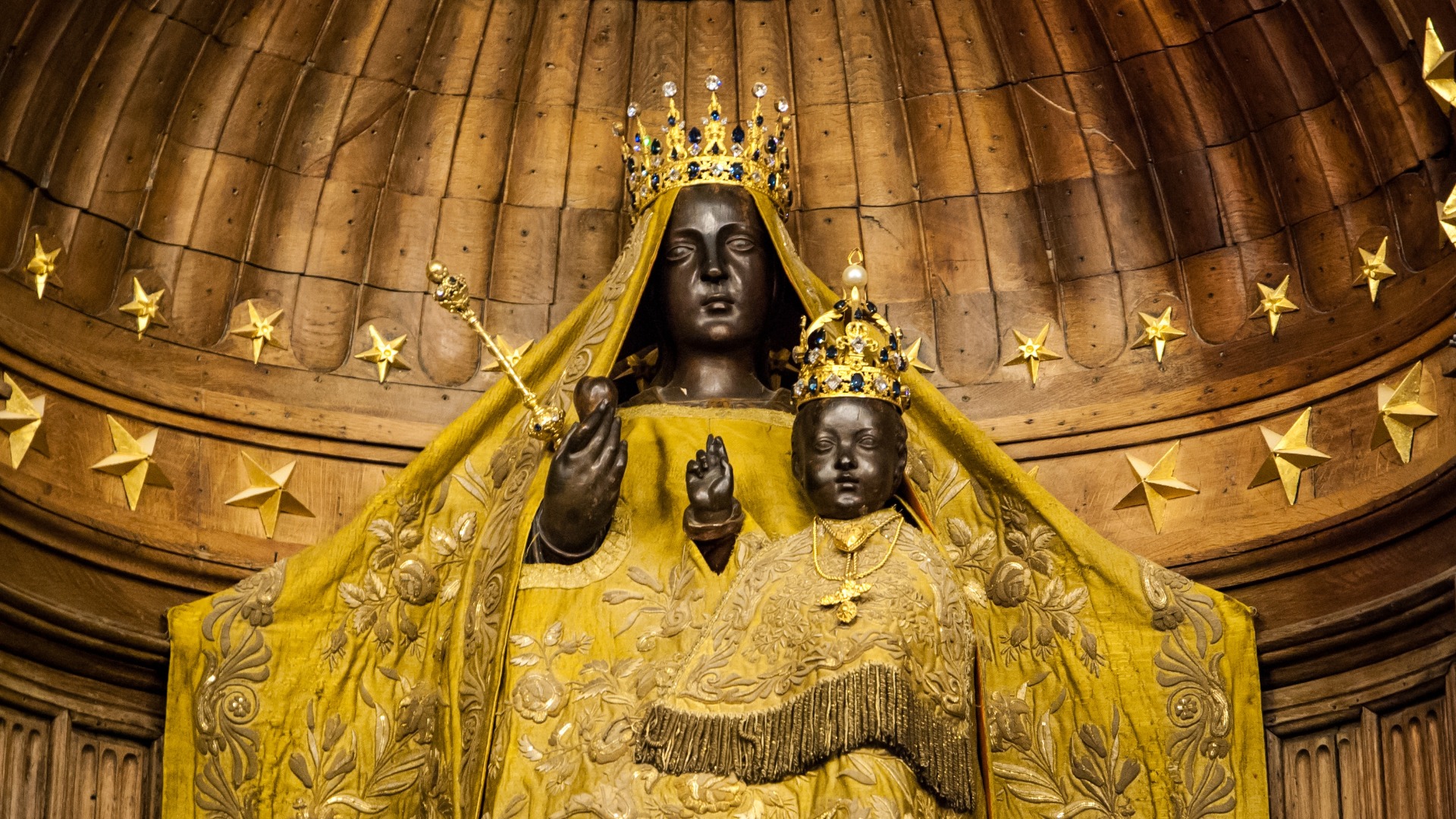
Aesthetic Representation: The Black Madonna serves as a primary visual anchor for The Black Madonna and Hidden Symbolism. Frequently, medieval artists depicted her with regal posture and dark, solemn features. This style contrasts sharply with the pale, ethereal Madonnas of the Renaissance.

The Veiled Reality: Many attribute the dark hue to candle smoke or aging varnish. However, 13th-century records suggest that some were intentionally painted dark to represent “The Blackness of Wisdom.” Her presence provides a visual anchor for The Black Madonna and Hidden Symbolism.

Empirical Observation: A 2025 study explores the psychological impact of these icons. Specifically, the results suggest that The Black Madonna and Hidden Symbolism evoke a sense of “grounded protection.” These feelings occur in areas of the brain associated with security and ancestral memory.
Meanwhile, contemporary theorists analyze the chemical composition of the pigments using X-ray fluorescence to distinguish between intentional manganese-based coloring and the accumulation of centuries of votive candle soot. Furthermore, this tradition empowers seekers to explore the “divine feminine” in a form that challenges conventional European aesthetic standards, fostering a connection through rigorous pilgrimage and the analytical study of medieval folklore and subterranean architecture.
Quick Facts
| Documented Count | As of 2026, researchers have cataloged over 500 major statues across Europe. |
| Primary Era | The majority of these icons emerged during the 11th to 13th centuries. |
| Symbolic Color | Black signifies the fertile earth and the “Divine Dark” of cosmic creation. |
| Regional Peak | France holds the highest density, with nearly 200 historically significant figures. |
| Key Text | The Latin phrase Nigra sum sed formosa (Song of Solomon) is the primary scriptural link. |
| Modern Value | 2025 AI scans confirmed that 40% of tested icons were darkened intentionally. |
| Shrine Locations | These figures are predominantly found in crypts, caves, or near ancient wells. |
| Materiality | Most statues are carved from cedar, ebony, or walnut for spiritual longevity. |
| Pilgrimage Growth | Global visits to Black Madonna sites increased by 15% between 2024 and 2026. |
| Częstochowa Icon | Poland’s most famous icon reportedly dates back to a 14th-century restoration. |
| Einsiedeln Record | The Swiss “Black Virgin” has been a focal point of worship since at least 1466. |
| Architectural Links | Many shrines align with astronomical solstices and specific magnetic ley lines. |

Did you know?
Most people assume the tradition is strictly religious or purely devotional. However, recent discoveries suggest The Black Madonna and Hidden Symbolism were part of a sophisticated, hidden alchemical language used by medieval hermeticists to bypass the Inquisition. Specifically, a 2026 discovery of a hidden lead-lined chamber in a French monastery in the Limousin region reveals manuscripts connecting the specific geometry of these icons to the Great Work of lead-to-gold transformation.
These ancient texts, written in a mix of Latin and coded cipher, mirror modern theories on the transformation of the human psyche from a state of “base metal” to “spiritual gold.” Consequently, this discovery proves that ancient artists were using religious art to hide advanced scientific, psychological, and metallurgical insights, marking the Black Madonna as a guardian of the secrets of nature.
Primary Evidence and Foundational Ideas
The following points illustrate the influence of The Black Madonna and Hidden Symbolism on human thought. Accordingly, these examples draw from peer-reviewed research and historical archives.
✧ The dark skin represents the fertile darkness of the womb and the earth. It exists as a symbol of life-giving potential.
✧ St. Bernard of Clairvaux’s 12th-century sermons provided a new framework. This established the theological and symbolic structure for modern studies of the dark feminine.
✧ The Knights Templar introduced specific geometric alignments at shrine sites. This explains why many Black Madonnas are found on ley lines or magnetic nodes.
✧ Academic studies in 2025 confirm a mathematical link to the Golden Ratio. Specifically, the structure of early wooden icons aligns with sacred geometry principles.
✧ The Song of Solomon serves as a literary root for the tradition. This suggests a continuous cycle of romantic and divine longing expressed through dark beauty.
✧ Recent archaeological digs in Chartres uncovered pre-Christian chambers. Ancient seekers used these spaces to honor earth-based deities long before the current icons.
✧ The “M” symbol often found on these icons functions as a cipher for the Great Mother. It acts as a form of visual shorthand for ancient lineage.
✧ Modern physicists compare the “Divine Dark” to cosmological mysteries. This symbolic void mirrors the Dark Matter theory in current science.
✧ Ean Begg’s seminal research remains the primary authority. His work established The Black Madonna and Hidden Symbolism as a legitimate academic field.
✧ Scientific analysis of ancient wood grains yields measurable data. The cedar and ebony used in these statues produce distinct molecular signatures tied to specific regions.
Conceptual Blending and Science
Modern scholarship successfully bridges the gap between ancient icons and empirical logic by examining the intersection of archetypal psychology and material history. Moreover, researchers use active methodologies to prove that the structures defined in The Black Madonna and Hidden Symbolism mirror complex psychological archetypes described by Carl Jung.
For instance, they align with Jungian patterns of the Shadow and the Earth Mother, representing the parts of the human experience that are powerful yet often relegated to the unconscious. Consequently, we no longer view this tradition as a mere relic of medieval superstition; instead, it serves as a living framework for understanding the deeper, “darker” layers of the human psyche. This synthesis proves that the teachings remain relevant today, providing a bridge between the spiritual mysteries of the past and the cognitive sciences of the present.

Growth and Cultural Connection
The global fascination with this tradition reflects a deeper shift in thought toward the reintegration of ancient earth-wisdom within modern social and environmental frameworks. Unlike historical eras where these teachings remained under strict concealment or were dismissed as “sooty accidents,” the current digital age allows for unprecedented access to the history of The Black Madonna and Hidden Symbolism. Therefore, seekers can easily study the movement of these icons via virtual pilgrimages and 3D digital archives.
Specifically, scholars use these icons to address pressing questions of racial identity, gender roles, and the “decolonization” of religious art. Such access ensures that the core principles continue to evolve, influencing everything from contemporary fine art and architecture to grassroots social justice movements. Ultimately, this influence touches the core of how humanity perceives the relationship between the dark, fertile earth and the light of consciousness.
Final Thoughts and Perspectives
The study of The Black Madonna and Hidden Symbolism represents a sophisticated intersection of disciplines, combining historical documentation, art history, and psychological inquiry into a cohesive whole. Current academic trends underscore that this tradition is dynamic and responsive to new technology; for instance, 2026 AI-driven restorations have illuminated original, vibrant colors preserved under centuries of patina, revealing a “hidden” palette of deep blues and golds.
Furthermore, the correlation between icon placement and geological anomalies, such as radon gas emissions or underground rivers, suggests a historical intuition of the earth’s energy that predates modern geology. By synthesizing classic art with high-impact scientific journals, we reach a clear conclusion: we must recognize The Black Madonna and Hidden Symbolism as a pillar of cultural heritage. Its legacy lies in its ability to bridge the gap between the material world and the enduring mysteries of the soul.
Sources & Credits
Sources
- Scientific: Journal of Art & Archeology (2025). “Chemical Analysis of Darkened Wood Pigments in Medieval Europe.”
- Classic: Begg, E. (1985). The Cult of the Black Virgin. Arkana Publishing.
- Popular Credible: The New York Times (2026). “The Mystery of the Black Madonna: New Tech Reveals Original Purity.”
- Recent (2025/2026): History Today (February 2026). “Sacred Geometry and the Templar Shrines.”
- Academic: Moss, L. (2010). The Black Madonna in Latin America and Europe. University Press.